Abstract
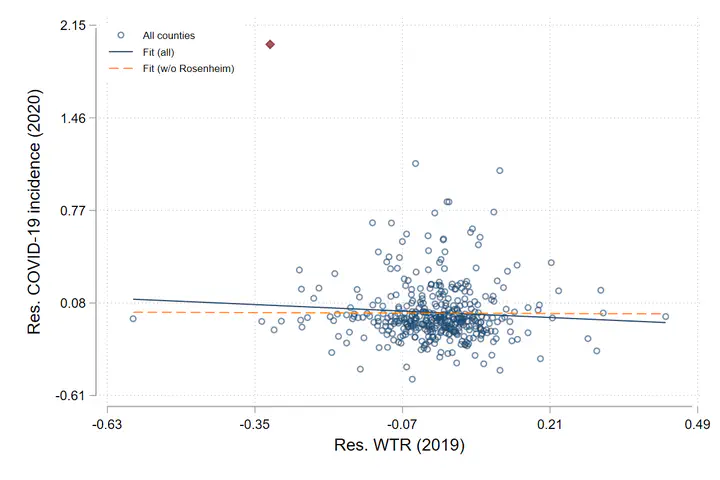
This paper explores the effect of COVID-19 infection rates on individuals’ risk preferences using the Socio-Economic Panel (SOEP), a large population-wide random sample. Exploiting county-level variation in a difference-in-differences design, we find that risk preferences remain unchanged: the effect is precisely estimated at 2.1% of a standard deviation (95% CI: [−0.4%, +4.6%]), ruling out economically meaningful shifts. This zero effect is broadly stable across subgroups of the population. Across a wide range of potential mediators, local exposure to COVID-19 increases financial worries and anxiety, but these responses do not translate into preference shifts: only life satisfaction qualifies as a mediator, with a negligible indirect contribution. These findings suggest that COVID-19 primarily alters the decision environment rather than deep preferences.

Johannes Seebauer
Postdoctoral Researcher
My research interests include labor economics, public economics, and economics of inequality.